Saturday, July 9, 2016

Friday, July 8, 2016
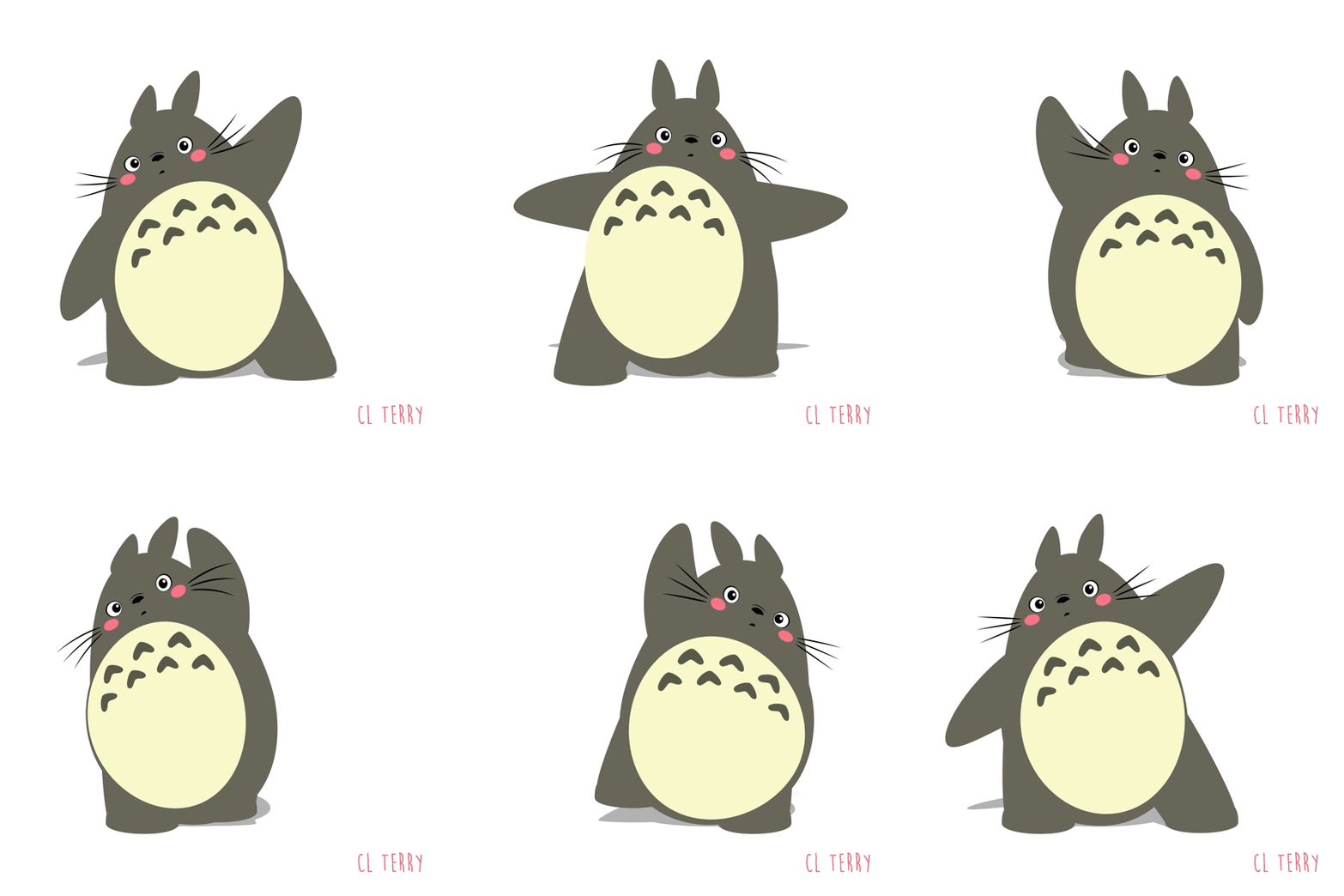
My Neighbor Totoro - Cutest Monster
 My Neighbor Totoro (となりのトトロ) is a 1988 Japanese animated fantasy film written and directed by Hayao Miyazaki.
The film won the Animage Anime Grand Prix prize and the Mainichi Film Award andKinema Junpo Award for Best Film in 1988. It also received the Special Award at the Blue Ribbon Awards in the same year.
The film was released on VHS and laserdisc in the United States by Fox Video in 1993 under the title My Friend Totoro. In 1988, Streamline Pictures produced an exclusive dub for use on transpacific flights by Japan Airlines. Troma Films, under their 50th St. Films banner, distributed the dub of the film co-produced by Jerry Beck. It was released on VHS and DVD byFox Video. Troma's and Fox's rights to this version expired in 2004.
The film was re-released by Walt Disney Pictures on March 7, 2006[1] and byMadman on March 15, 2006.[2] It features a new dub cast. This DVD release is the first version of the film in the United States to include both Japanese and English language tracks, as Fox did not have the rights to the Japanese audio track for their version. The movie and its titular character, Totoro, have become cultural icons. My Neighbor Totoro ranked #41 in Empire magazine's "The 100 Best Films Of World Cinema" in 2010.[3] A list of the greatest animated films compiled byTerry Gilliam in Time Out ranked the film number 1.[4] A similar list compiled by the editors of Time Out ranked the film number 3.[5]The character made multiple cameo appearances in a number of Studio Ghibli films and video games and is recognized as one of the most popular characters in Japanese animation. Totoro was ranked 24th on IGN's top 25 anime characters.[6]
The film tells the story of the two young daughters (Satsuki and Mei) of a professor and their interactions with friendly wood spirits in postwar rural Japan.
Castle in the Sky - Adventure of A Brave Girl
 Laputa: Castle in the Sky (Japanese: 天空の城ラピュタ) is a 1986 Japanese animated adventure film written and directed by Hayao Miyazaki and is also the first film produced and released by Studio Ghibli. It won the Animage Anime Grand Prix in 1986.
Although meaningless in Japanese, the name "Laputa" comes from Jonathan Swift's Gulliver's Travels. English language dubs of Laputa have been released under three different titles by three separate distributors, which is largely due to the similarity to the Spanish slang "la puta" (lit. "the whore"), which would be offensive to many.
Laputa is a once-great floating city in the sky. The city was technologically advanced in its prime, and its inhabitants were able to coexist harmoniously with nature. The Laputian people lived peacefully until they were forced to flee the city due to an unnamed catastrophic event. Castle in the Sky is set many years after Laputa was deserted, and it is no more than a myth in most people’s eyes.
In the film, a girl named Sheeta is sought after by pirates as well as the military (led by Muska, an extremely ambitious man with his own agenda); both groups are after the crystal necklace in her possession, as they all believe it is the key to finding Laputa and unlocking its secrets. In a desperate escape attempt, Sheeta falls from an airship and—literally—lands in the arms of Pazu, a hardworking youth whose dream is to follow in his father’s footsteps and see Laputa with his own eyes. The duo are then swept up in a fierce race to reach Laputa before the military and save it from being used as a tool for military advancement or a means to satisfy greed.

Thursday, July 7, 2016
Whisper of the Heart - Romantic Story
 Whisper of the Heart ( 耳をすませば ) is a 1995 Japanese animated romantic drama film directed by Yoshifumi Kondō and written by Hayao Miyazaki based on the 1989 manga of the same name by Aoi Hiiragi. The film stars Yoko Honna, Issei Takahashi, Takashi Tachibana, Shigeru Muroi,Shigeru Tsuyuguchi and Keiju Kobayashi. It was the first theatrical Studio Ghibli film to be directed by someone other than Miyazaki or Isao Takahata.
Whisper of the Heart was Kondō's only film as director before his death in 1998. Studio Ghibli had hoped that Kondō would become the successor to Miyazaki and Takahata.[1]
A related film entitled The Cat Returns that focused on a minor character of the film, Baron, was released in 2002.
Spirited Away - Welcome to the fantasy
 Spirited Away (千と千尋の神隠し) is a 2001 Japanese anime fantasy film written and directed by Hayao Miyazaki.
It claims as the most successful film in Japanese history, grossing about $289 million worldwide and receiving widespread critical acclaim. The film overtook Titanic (at the time the top grossing film worldwide) in the Japanese box office to become thehighest-grossing film in Japanese history with a ¥30.4 billion total. Spirited Away is frequently ranked among the greatest animated films.[8][9][10] It won the Academy Award for Best Animated Feature at the 75th Academy Awards (Making it the only hand drawn animated film and Japanese animated film to win best animated film), the Golden Bear at the 2002 Berlin International Film Festival (tied with Bloody Sunday) and is among the top ten in the BFI list of the 50 films you should see by the age of 14.
It tells the story of Chihiro Ogino (Hiiragi), a sullen ten-year-old girl who, while moving to a new neighborhood, enters the spirit world. After her parents are transformed into pigs by the witch Yubaba (Natsuki), Chihiro takes a job working in Yubaba's bathhouse to find a way to free herself and her parents and return to the human world.
Miyazaki wrote the script after he decided the film would be based on the ten-year-old daughter of his friend, associate producer Seiji Okuda, who came to visit his house each summer.[6] At the time, Miyazaki was developing two personal projects, but they were rejected.
With a budget ofUS$19 million, production of Spirited Away began in 2000. During production, Miyazaki realized the film would be over three hours long and decided to cut out several parts of the story. Pixar director John Lasseter, a fan of Miyazaki, was approached by Walt Disney Pictures to supervise an English-language translation for the film's North American release. Lasseter hired Kirk Wise as director and Donald W. Ernst as producer of the adaptation. Screenwriters Cindy Davis Hewitt and Donald H. Hewitt wrote the English-language dialogue, which they wrote to match the characters' original Japanese-language lip movements.[7]
With a budget ofUS$19 million, production of Spirited Away began in 2000. During production, Miyazaki realized the film would be over three hours long and decided to cut out several parts of the story. Pixar director John Lasseter, a fan of Miyazaki, was approached by Walt Disney Pictures to supervise an English-language translation for the film's North American release. Lasseter hired Kirk Wise as director and Donald W. Ernst as producer of the adaptation. Screenwriters Cindy Davis Hewitt and Donald H. Hewitt wrote the English-language dialogue, which they wrote to match the characters' original Japanese-language lip movements.[7]
Wednesday, July 6, 2016
Grave of the Fireflies - Most Traumatizing Animated Movie
 Grave of the Fireflies (火垂るの墓 Hotaru no haka) is a 1988 Japanese animated war drama film written and directed by Isao Takahata and animated by Studio Ghibli. It is based on the 1967 semi-autobiographical short story Grave of the Fireflies by Akiyuki Nosaka.
 Set in the city of Kobe, Japan, the film tells the story of two siblings, Seita and Setsuko, and their desperate struggle to survive during the final months of the Second World War. The film was critically acclaimed. Roger Ebert of the Chicago Sun-Times considered it to be one of the best and most powerful war films. It is commonly described as an anti-war film, but this interpretation has been denied by the director.
Setsuko and Seita are brother and sister living in wartime Japan. After their mother is killed in an air raid they find a temporary home with relatives.

Having quarreled with their aunt they leave the city and make their home in an abandoned shelter. While their soldier father's destiny is unknown, the two must depend on each other to somehow keep a roof over their heads and food in their stomachs. When everything is in short supply, they gradually succumb to hunger and their only entertainment is the light of the fireflies.

Although they were having a hard time, they were easy to satisfied. They could be happy because of minor things. Because they still were children in young age. It is also why this movie is called the Most Traumatizing Animated Movie. They had experienced wartime which they could not control, even they didn't know what war was.

Many audiences dropped their tears when watching the scenes of Setsuko was suffering from malnutrition but offers no help. And Seita only could find his sister is dying. He brought food to find her and cooked hurry but she died soon after.

The relationship between this young brother and little sister was one of the main focus of the movie. It shows the mind-change of Seita from being annoyed of Setsuko to wiling to take care her and feeling sad because of her. The fruit drops which used by Seita to make his sister happy is the most memorable features too.

Movie Trailer
Subscribe to:
Posts (Atom)